Who Gets to Be Happy? | Part 3 of 4
This is part of a four-part Memories Architect series about happiness, freedom, and the forces that shape how we live. We're challenging the scripts we're handed, questioning who benefits from our dissatisfaction, and exploring a simple but powerful idea: everyone deserves the opportunity to build a life filled with joy and memories worth keeping.
What Does It Really Take to Make a Happy Memory?
Think about one of your happiest memories. Maybe it's a family dinner filled with laughter, a spontaneous road trip, or an afternoon sitting beside someone you love. Now consider what made that memory possible.
Perhaps you needed money for gas, time away from work, a safe place to gather, or simply enough breathing room to enjoy the moment.
Yesterday, I shared how much happiness I've found in the simple ritual of having dinner with Wade. But what about the couple working opposite shifts to afford their home? The parent missing dinner because they're working a second job?
What happens when the greatest obstacle to making joyful memories isn't our willingness to pursue happiness, but the circumstances of our lives?
The Lesson I Brought Home From Thailand
In 2000, I found myself on a long-tail boat, cruising the waterways of Bangkok, Thailand. I had no idea how much that afternoon would challenge what I'd been taught about poverty.
From the water, the poverty was impossible to ignore. Dilapidated houses lined the waterways. People washed clothes in the river and cooked meals over open fires. The contrast with the relative comfort I'd known growing up in America was startling.
But there was something else I couldn't ignore.
Children splashed and played in the water. Groups of women sat together laughing. Men gathered around games. Vendors navigated boats loaded with goods, working to sell their wares at floating markets and to tourists like us.
Everywhere I looked, people were working, playing, connecting, and living.
I'd grown up absorbing the idea that poverty was the result of not working hard enough. That people in poorer countries were somehow less ambitious, less industrious, and inevitably miserable.
Yet that wasn't what I witnessed.
I hadn't expected to see so much joy. And the uncomfortable truth was that my surprise revealed more about my own conditioning than it did about the people I was observing.
Of course, a tourist passing through cannot understand the full circumstances of someone's life. And I certainly don't want to romanticize poverty. Hunger isn't charming. Inadequate housing isn't a lesson in simplicity.
The ability to find joy despite hardship is not a justification for allowing hardship to continue.
That afternoon began changing how I understood poverty, privilege, and the assumptions we make about people whose lives look different from our own.
When Free Isn't Really Accessible
Years later, I encountered another lesson while working in the Medicaid division of a major health insurance company. My job involved helping people access preventive healthcare, including screenings and vaccinations covered at no cost to eligible members.
Initially, I struggled to understand why people weren't using their benefits.
If your mammogram is free, why wouldn't you get one?
Then I got into the field and started listening.
What does a free mammogram mean to a mother working three jobs to feed her children, who can't afford to miss work? How does someone experiencing homelessness prepare for a colonoscopy when they don't have access to a private, functioning bathroom?
I learned that informing people about their benefits wasn't the same as helping them use those benefits. We needed mobile mammography, vaccination clinics at shelters, and programs designed around the realities of people's lives.
Just because something is available doesn't mean it's accessible.
And as Veterans Day approaches, I think about the people we honor for their service. Some veterans living with PTSD face additional challenges seeking medical care because certain environments or procedures can trigger trauma-related distress. Honoring their service should also mean understanding and addressing the barriers they may face when seeking support.
My healthcare career taught me that we cannot solve problems we haven't taken the time to understand.
And that lesson extends far beyond healthcare.
What Are We Actually Voting For?
I am political. Because life is political.
The decisions made in government offices eventually find their way into our kitchens, classrooms, hospitals, neighborhoods, and the memories we have the opportunity to create.
When I vote, I think about the kind of world I want people to live in. One where a medical diagnosis doesn't lead to financial ruin. Where families have clean water and safe homes. Where public parks give children room to play and communities places to gather. Where education expands minds and opens doors to dreams beyond the circumstances of someone's birth.
I believe in hard work, ambition, and success. I've spent my career helping organizations and people grow. But I also believe that working hard should offer people a reasonable chance at stability, and that someone else's success shouldn't depend on keeping others from having enough.
We can disagree about how best to achieve those goals. But I hope we can recognize that behind our debates about healthcare, housing, education, and economic opportunity are real people trying to build meaningful lives.
I don't believe we have to make someone else's life smaller to make our own lives better.
When I think about prosperity, I don't measure success only in dollars or profits. I think about children playing in parks, families gathered around dinner tables, grandparents attending school concerts, and friends who can afford to drive across town when someone they love needs them.
Those aren't simply economic outcomes or political talking points. They're the moments that become our lives, the relationships that give them meaning, and the memories we carry with us.
And I want more people to have the opportunity to make them.
The pursuit of happiness should be more than a promise. Everyone deserves a meaningful opportunity to pursue it.
Your Merrymaker Mission
Think about something that gives you the freedom to enjoy your life. Stable housing, healthcare, time with family, or the ability to show up when someone needs you.
Now imagine life without that security.
This week, listen to someone whose circumstances differ from yours. Instead of assuming you understand their struggles, get curious about the barriers they're navigating.
Because sometimes, creating more room for joy begins with understanding what stands in someone else's way.
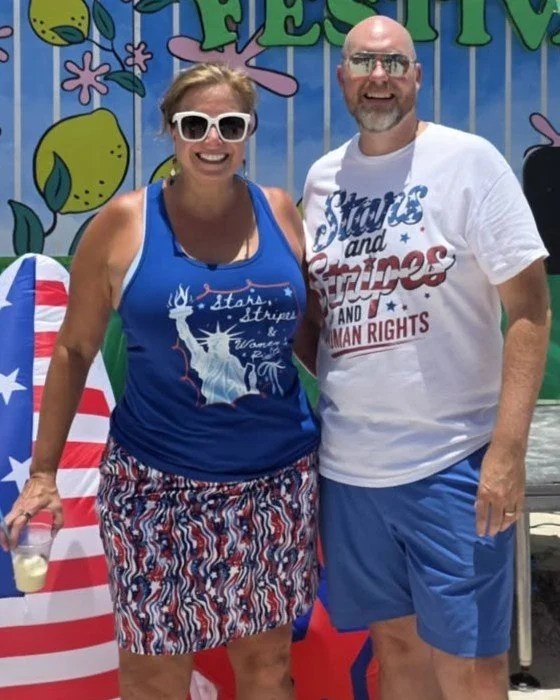
Stars and Stripes and Human Rights
Wade and I celebrating at Key Lime Fest, proudly wearing our values. For us, loving our country means believing that freedom, dignity, opportunity, and the pursuit of happiness should belong to everyone. Standing up for someone else's rights doesn't diminish our own.
Next in the series: Joy Shouldn't Be a Radical Act
We've explored the expectations we're handed, the industries that profit from our dissatisfaction, and the circumstances that shape our opportunities for joy.
In our final installment, we'll ask: What would change if we stopped treating someone else's happiness as a threat to our own?
And yes, some people may find that question uncomfortable. Maybe that's not such a bad thing.